Atlanta Housing Projects: Gone But Never Forgotten – The Story of the Atlanta Housing Projects 1936 – 2011

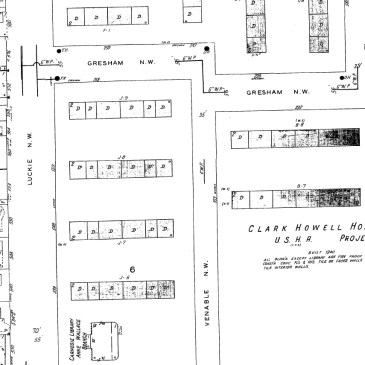
Capitol Homes Sanborn Map
Capitol Homes as it appears in a 1940’s Sanborn Map (Capitol Homes was completed in 1941)

While the majority of my blog mostly focuses on abandoned historical Atlanta relics, I thought it would be interesting to make a post about a huge gentrification project in the city that drastically changed the landscape of the city. Most transplants wouldn’t know that housing of this nature existed, mostly because the areas have been completely transformed and cleared of ant remnants of what once existed. The huge gentrification project I am referring to was the large scale, housing project demolition spearheaded by the Atlanta Housing Authority. The project began in the late 1990’s (demolishing Techwood Homes and East Lake Meadows), was finally completed in the 2010’s with the demolition of Bankhead Courts. For a complete list of former housing projects in Atlanta, visit Demolished Atlanta Housing Projects. After researching George W. Adair in the book “Atlanta and Environs, Volume III,” I ran across a chapter concerning the Atlanta Housing and Authority and major developer who was credited with building the first set of projects in Atlanta in the 1030’s. This article piqued my interest in completing a little bit of research on the housing projects that I could find.

After researching George W. Adair in the book “Atlanta and Environs, Volume III,” I ran across a chapter concerning the Atlanta Housing and Authority and major developer who was credited with building the first set of projects in Atlanta in the 1030’s. This article piqued my interest in completing a little bit of research on the housing projects that I could find.

Current views of the city of Atlanta show no traces of housing projects. The housing projects of Atlanta are all but wiped from the landscape of Atlanta. Most natives (who are hard to find in Atlanta these days) vividly remember the housing projects of Atlanta. What we have been told throughout history is housing projects were constructed in hopes of erasing slums, increasing affordable housing options for the city’s poor all while improving the landscape of Atlanta; which ultimately evolved into areas blighted with concentrated poverty. However, Harold Martin’s “Atlanta and Environs” reveals an alternate truth behind the implementation of housing projects in Atlanta.

This slideshow requires JavaScript.

The very first housing projects constructed (federal subsidized housing) in the United States happened to be Techwood homes. Built in 1936, Techwood homes consisted of 1,230 housing units. Prior to the construction of Techwood-Caldwell Homes, the area was home to some of the worst areas of concentrated poverty in the city of Atlanta, named Techwood Flats. Techwood Flats consisted of inexpensive, inadequate rental properties that dated back to the late 1880’s. The Atlanta City Directory revealed that most residents of the area were employed in low-paying service jobs in warehouses or industrial plants in the city. The most common occupations were cooks, dressmakers or washerwomen.

Though we have been told that housing communities were created as a method to provide the poor with affordable and hospitable housing, many developers jumped on the project to earn a quick living. Building sustainable, affordable and safe housing was not a part of the initial plan in their eyes. Touted as a “slum clearance pioneer” by Harold Martin,  Atlanta real estate developer Charles F. Palmer initially jumped on the large scale housing project as a way to make quick cash. Charles F. Palmer also happened to be the very first chairman of the board of the newly formed Atlanta Housing Authority in 1938.
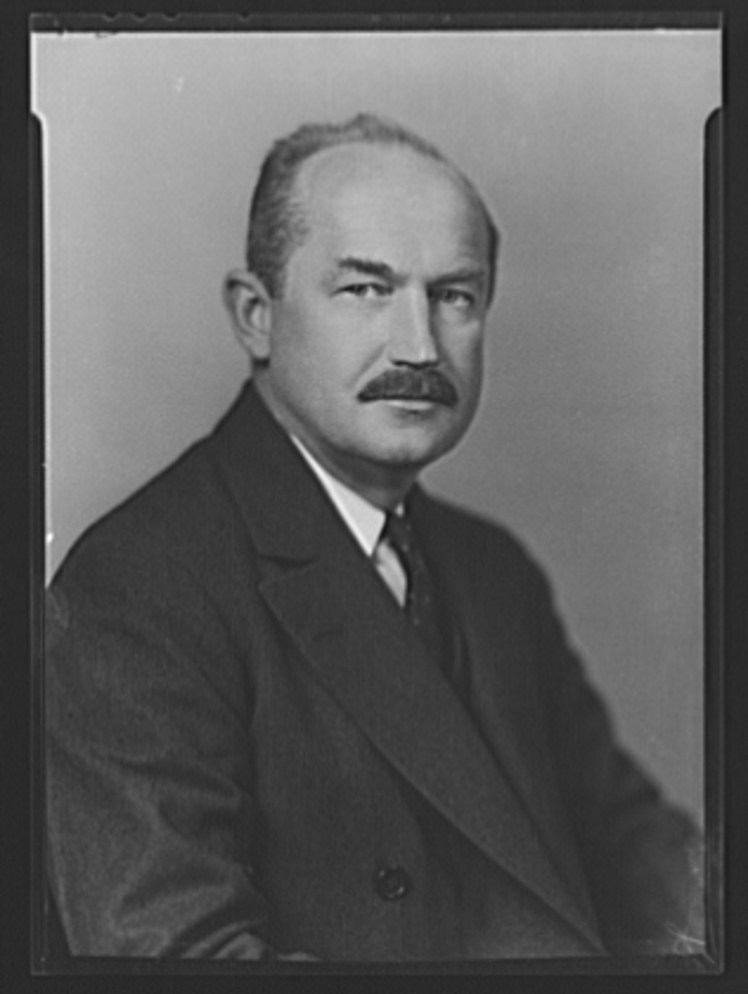
Charles F. Palmer

Charles F. Palmer (courtesy of Library of Congress). First Chairman of the Board of Atlanta Housing Authority. The Atlanta Housing Authority was formed in 1938.

Initially, Charles F. Palmer admitted that he took on the slum clearance project out of an interest in earning money through the removal of slum areas. After all, this was in 1933 as the economy wasn’t at it’s strongest due to remnants of the Great Depression. Banks were closed and nearly 15millions Americans were unemployed (only 1 in 16 were employed). In order to stimulate the economy, President Roosevelt introduced legislation that would provide federal funding for employers who created jobs tearing down and rebuilding some of the nation’s worse slum areas. Palmer jumped at the chance, seeing as he owned office buildings in areas near the slums. Palmer initially assumed that by clearing the slums, property values in his area would increase, thereby making his properties more valuable.

It wasn’t until he began to meet with Dr. John Hope (John Hope homes would carry his name), a prominent African-American educator and civil right leader, and his wife did Palmer have a change of heart toward the slums. Palmer’s wife seemed to question his motivation and asked him if he’d ever visited the slums and understand the people who currently reside there.  Palmer recalled:

“Here were sagging shacks built generations ago. Designed to wring the last cent from their use, for fifty years they had taken all and given nothing. In the rear were stagnant pools of water near an open privy serving several families. People were everywhere. It was the same block after block. Soon I’d had enough. “

Palmer soon switched his focus from earning income by razing the slums, to fighting the slum owners who were taking advantage of the city’s poorest residents. Palmer took his concerns to Washington D.C. and managed to convince President Roosevelt to fund the development of two housing projects in Atlanta; in October of 1933, his efforts were awarded. Construction of the first housing projects community in the United States was underway and completed in 1936. Techwood Clark Howell Homes (designed by architects Burge and Stevens) were built in the former slum areas of Techwood Flats. By 1944, six additional housing projects (all were segregated, unfortunately) were completed. Those communities are as follows:  University Homes (1938), Capitol Homes (1940), Grady Homes (1942), John Hope homes (1940), Herndon Homes (1940) to name a few. By the 1940’s these six housing communities housed 20,000 people in a total of 4,000 apartment homes. The government ultimately invested $21 million dollars into improving housing for the poor in Atlanta. Techwood Clark Howell homes and John Hope homes were aptly named for the two men who were instrumental in the implementation of Charles F. Palmer’s vision of affordable, clean housing for Atlanta’s poorer residents. As a result of Palmer’s vision, Roosevelt passed the Housing Act of 1937, which allowed for local housing authorities in many major and rural cities. Palmer would ultimately resign from his position at the Atlanta Housing Authority to take on a new role as U.S. Coordinator of Defense Housing in 1938 (pgs 35-37).

Techwood Homes Floor Plan

Library of Congress, Techwood Homes Housing Design (initial construction began in 1935)

One cannot ignore the ugly facts about the housing projects of Atlanta. The housing communities were obviously segregated and quite possibly built with many different standards. As white flight encroached, white housing communities racial makeup drastically changed.  Techwood Homes remained an all-white housing project until 1968. Withing 6 years of integration, Techwood Homes was more than 50% African-American. By the early 1970’s local businessmen and politicians began suggesting the demolition of Techwood Homes, replacing it with. If this isn’t an obvious sign of racially motivated politics, I don’t know what it is. Techwood Flats were mostly comprised of low-income, underemployed African-American’s in the 1930’s before being demolished and replaced with the all-white Techwood Homes. It appeared that Atlanta was on track to repeating history, however, the idea of demolishing Techwood Homes in the 1970’s was halted by then mayor, Maynard Jackson.

Unfortunately, federal spending wasn’t designated over the years regarding the upkeep of housing communities, yet Atlanta continued to build low-income housing.  Many of the housing communities were built in cramped areas, containing very little room for upward mobility as a job in these areas were still hard to come by. As a result, crime crept it’s way back in, and once again the pre-housing community slums had returned. What’s more, the Atlanta Housing Authority had become increasingly corrupt and poorly managed. By the 1990’s,  The Department of Housing and Urban Development deemed the AHA to be one of the worst housing authorities in the nation. Ouch!

Atlanta continued to build more and more housing communities, even as late as the 1970’s despite the failure of creation a “Model City.” Was the new purpose of building housing communities to keep African-American’s concentrated in Atlanta and out of Atlanta’s growing suburbs? Why continue to build substandard housing in areas that already contained concentrations of poverty? Wouldn’t the availability of well-paying jobs and equal rights assist with the reduction of concentrated poverty? I suppose only time will tell…..

After years of failed revitalization and high crimes/poverty rates in Atlanta’s local housing communities, as well as the impending hosting of the 1996 Summer Olympic Games, demolishment of the Atlanta housing communities were underway. Additionally, housing project communities had become the subject of a major research project which resulted in Congress establishing a 1989 Commission on Severely Distressed Areas.  Flash forward to 1992, concerned with the increasing crime and poverty in America’s inner-cities, congressional leaders voted to allocate $5 billion dollars toward the revitalization of America’s 86,000 housing project communities (enactment of the HOPE VI program). I’m a bit skeptical of the intentions behind this program, therefore further research will soon follow.

The first to be demolished was Techwood /Clark Howell Homes in favor a newer, more hospitable housing complex titled Centennial Place. After 60 years of use, Techwood would be replaced with a mixed-income housing community with only a tiny portion set aside for former housing project residents. Many former residents weren’t able to return despite being promised a voucher or ticket to rent in the new construction. From 1996 to 2011, the AHA replaced 12 housing project communities, demolished 15, and remodeled the remaining 10 converting them into low-income housing or leaving them available for potential developers. By 2011, Atlanta became one of the only major cities to completely do away with public housing. This move came with much controversy as the AHA was accused of violating the Fair Housing Act (an accusation I truly believe is true) after it was determined that the AHA

Currently, affordable housing in Atlanta is hard to come by. Luxury apartments, homes and condos now stand in areas once occupied by outdated, uninhabitable housing communities. While the housing projects were obviously a colossal failure, the city of Atlanta should not forget that the city is desperately in need of affordable housing for residents who cannot afford the newly constructed condos, apartments, and single-family homes. I doubt that anyone would agree with bringing back housing project communities, but the city should at least offer a larger percentage of affordable housing units so that all residents, from all walks of life, can enjoy the metropolis that Atlanta has blossomed into. After all, it takes all kinds of characters, economic backgrounds, races, genders, and ages to create this amazingly diverse city we all call home. Why exclude certain residents because of their economic status? Is that a reputation a city “Too Busy to Hate” would like associated with its name? I think not…..

This slideshow requires JavaScript.

Sources:

  1. Atlanta History Center – Atlanta Housing Authority Photograph collection
  2. http://www.georgiaencyclopedia.org/articles/arts-culture/techwood-homes
  3.  Franklin Miller Garrett, Atlanta, and environs: a chronicle of its people and events, vol. 3 (Athens: Univ. of Georgia Press, 2011).

Further Reading:

  1. https://en.wikipedia.org/wiki/Atlanta_Housing_Authority
  2. http://www.atlantahousing.org/history.php
  3. Chared F. Palmer Collection at Emory University: https://findingaids.library.emory.edu/documents/palmer9/#descriptive_summary
  4. https://en.wikipedia.org/wiki/John_Hope_(educator)
  5. http://www.atlantahousing.org/docs/hope-vi-mcdaniel-glenn.pdf
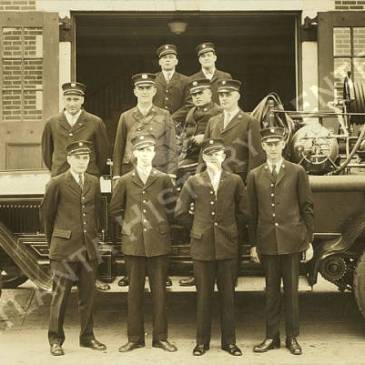


Fire Station No. 5 – Circa. Early 1920’s or late 1910’s

This slideshow requires JavaScript.

Name: Fire Station No. 5 (Company 5)

Location:  278 Trinity Avenue (formerly Peters Street)

As you may recall from my previous posts, you can tell that the downtown Atlanta area is full of abandoned historical buildings, as well as what remains of a former historical dwelling or building. One of many remnants of Atlanta’s past is the Fire Station No. 5 park located t 278 Trinity Avenue, formerly known as Peters Street.

A further investigation concerning Fire Station No. 5 reveals that Trinity Avenue was not it’s the first location and most certainly isn’t its final location presently.

According to Mike Legeros, author of “Atlanta Former and Historic Fire Stations,” the original location of Fire Station No. 5 was on Foundry and Marietta street in 1871 in a stable. The original name for the fire station, chartered October 15, 1871, was Gate City Fire Company No. 5. However, it’s location on Foundry and Marietta Streets would be temporary until a permanent location was built. Unfortunately, the original building that housed Fire Company No. 5 is no longer standing.

Fire Company No. 5 moved into its new headquarters at 28 E. Foundry Street on February 25, 1879, and remained there until 1882. The cost of the new building was billed at $1,500, which would cost a whopping $34,651.38 in today’s money figures. Unfortunately, Company No. 5 was disbanded on June 20, 1882, when the city of Atlanta created paid fire departments.

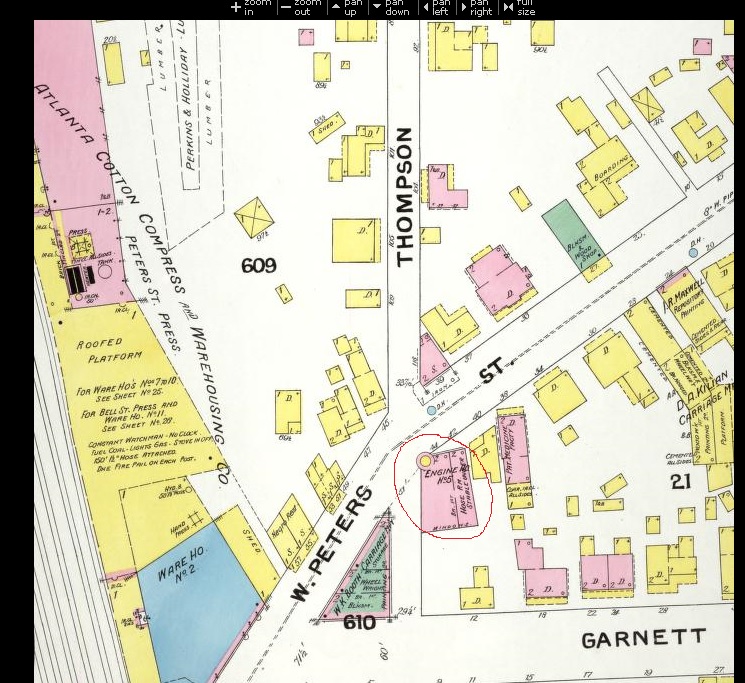
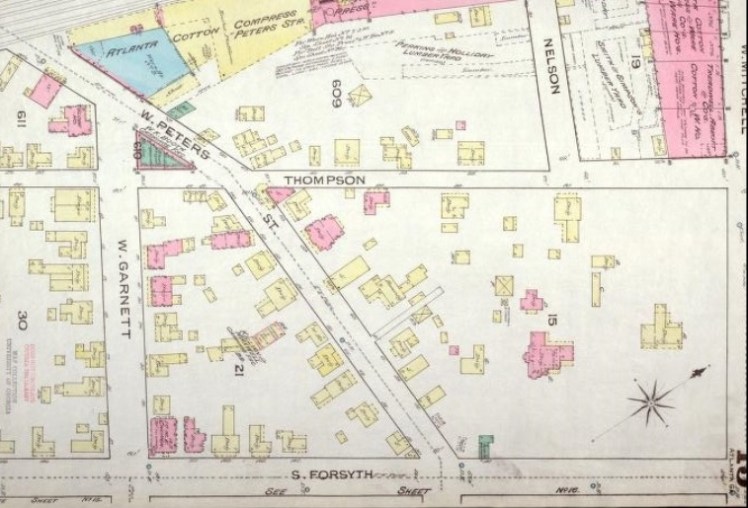
Eight years after the disbanding of Gate City Fire Station No. 5 in 1882, Company No. 5 was reorganized on December 1, 1890 with its new location at 44 West Peters Street. The company’s new location appeared for the first time on Sanborn Maps around 1892. Below, you can see that the company was simply referred to as “Engine No. 5.” Company

Fire Station No. 5_Sanborn Map 1892


This slideshow requires JavaScript.

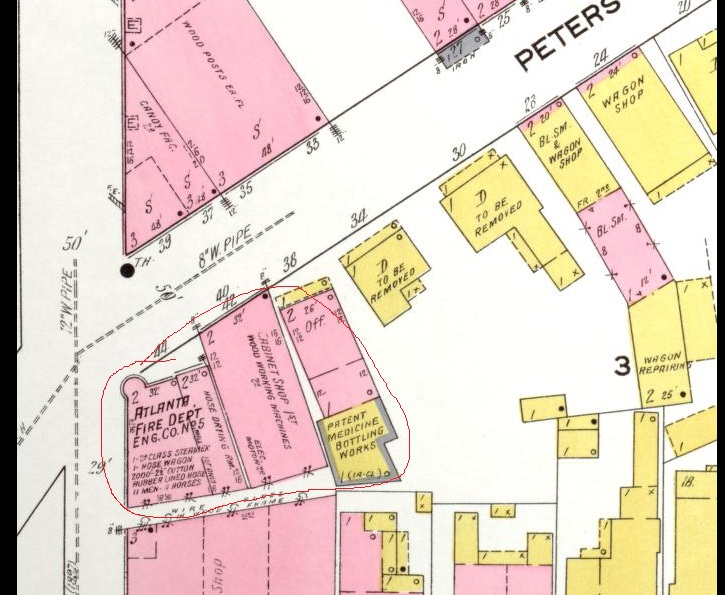
In 1911, the name of Company No. 5’s fire station location on W. Peters street is listed as Atlanta Fire  Department, Engine No. 5″ according to a 1911 Sanborn Map. The map also lists the company as having 11 men and 9 horses.


Fire Station No. 5_Sanborn Map 1911 closer look
1911 Sanborn Map of Fire Company No. 5 – Located at 44 W. Peters Street


In 1921 the Atlanta Fire Station No. 5 is listed in the Atlanta City Directory as well,  including the name of the fire captain at the time. According to the Atlanta City Directory, paid Atlanta fire departments were organized July 1, 1882. The directory goes on to mention the names of the fire chief, captains, lieutenants, etc. for each department.

City Directory listing 1921
Atlanta City Directory – 1921

Perhaps the expansion of the paid Atlanta Fire Department was the catalyst behind Fir Company No. 5’s new building to be erected at the same site as the previous building that housed the company from 1890-1927. By 1928, West Peter’s street was now named Trinity Avenue and the new address for Company No. 5 was 278 Trinity Avenue. Company No. 5 would remain at the 278 Trinity Avenue location from 1927 – 1965.

This slideshow requires JavaScript.

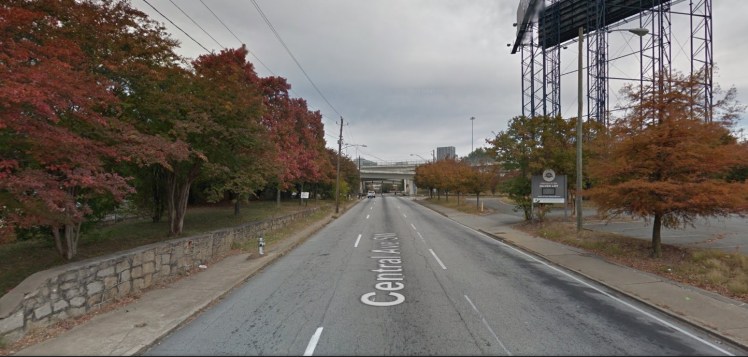
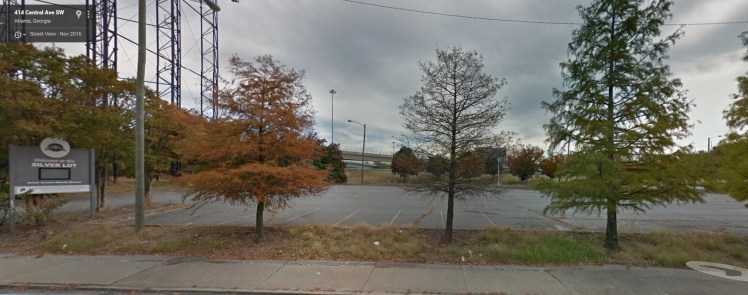
On July 1965, Company No. 5 relocated for the 5th time, though it would not be its last relocation. The 1965 location for Company No. 5 was 414 Central Avenue a few blocks away. The original 1927 fire station was deemed “vintage” and no longer suitable for modern day fire department equipment. The old location on 278 Trinity Avenue was demolished and marked with a placard that remains to this day. It is now known as Fire Station No. 5 park, located at the corners Spring St. and Trinity Avenue. Remnants of the brick walls that housed the 1927 Fire Station No. 5 remain visible. Unfortunately, after nineteen years on Central Avenue, Fire Station No. 5 would once again face uncertainty.

In order to make way for new construction of the downtown interstate connector, Fire Station No. 5 was closed after May 24, 1984. As a result of the demolition of the Central Avenue station, Company No. 5 disbanded June 30, 1984. Company No. 5 would go on to regroup as Squad No. 5, becoming the City of Atlanta’s Hazardous Materials Response Team; Fire Engine No. 5 was donated to Fire Company No. 9 and Squad 5 would go on to operate out of Fire Station No. 1. Fire Station No. 5’s building wasn’t fully demolished until 1988. Company 5 would ultimately reorganize in June of 1991 at a South West Atlanta location on 2825 Campbellton Road SW.

The new location would go on to house the most updated, state-of-the-art fire fighting equipment. As of 2001, only a handful of historic Atlanta Fire Department stations remain. Station No. 6 on Martin Luther King Jr. Drive remains and has been converted into a museum for the National Park Service. Built in 1894, and currently located in Sweet Auburn, remained in service until 1991. It is currently a part of the Martin Luther King Jr. historic district and serves as a museum. Museum goers will be treated to the history of Fire Station No. 16, which was the first fire station to be desegregated. African-American neighborhoods were not serviced by all-white fire departments as late as the 1940’s! An article from April 1949 edition of the Atlanta Daily World newspaper, highlights the need for desegregation of Atlanta’s Fire Departments. Fire Station No. 16 museum will hopefully mention this issue as it provides visitors with the history of the Atlanta Fire Department as a whole.

This slideshow requires JavaScript.

Currently view of 414 Central Avenue, home to the 5th relocation of Company No. 5.

Current View of 414 Central Avenue
Current location of 414 Central Ave – Turner Field Parking Area
Current View of 414 Central Avenue pt 2
Current View of 414 Central Avenue – Formerly Company No. 5


Sources:

  1. http://legeros.com/history/atlanta/atlanta.pdf
  2. History of Service: Atlanta Fire Department Commemorative Yearbook, vol. 1 (Paducah, KY: Turner Publishing Company, 2001).
  3. Sanborn Maps
  4. https://www.nps.gov/malu/learn/historyculture/fsn6-brief-history.htm
  5. “Mayor Ragsdale and Chief Cody Preside at Barbecue as Station no. 5 is Opened.” 1927.The Atlanta Constitution (1881-1945), Jul 16, 7. http://ezproxy.gsu.edu/login?url=http://search.proquest.com.ezproxy.gsu.edu/docview/500009602?accountid=11226.
  6. Jackson, Marion E. 1949. “Atlanta One of Large Southern Cities with no Negro Fire Unit.” Atlanta Daily World (1932-2003), Apr 20, 1. http://ezproxy.gsu.edu/login?url=http://search.proquest.com.ezproxy.gsu.edu/docview/490878782?accountid=11226.


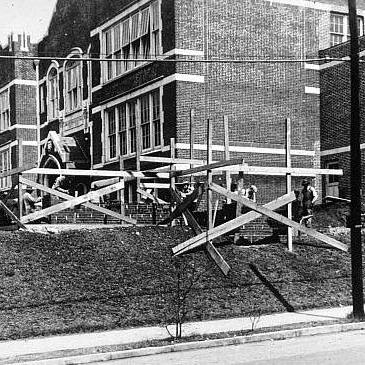
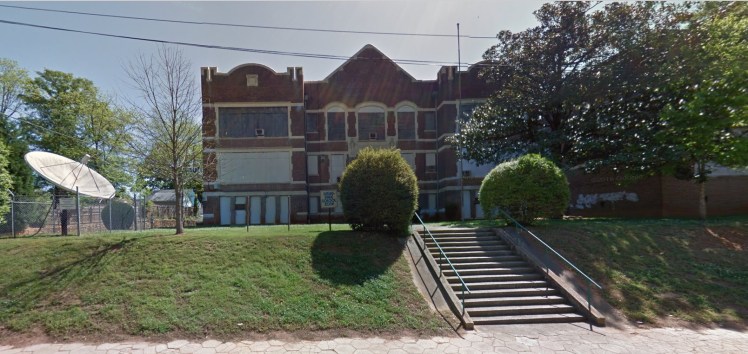
George W. Adair Elementary School – Circa. 1912

Adair Park Elementary

Name: George W. Adair Elementary School

Location: 141 Catherine Street, Atlanta, GA

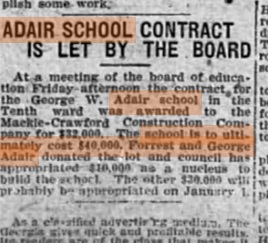
George W. Adair Elementary School, located in the historic Adair Pair neighborhood, sits abandoned yet still maintains it’s architectural glory. Upon further inspection, onlookers are treated beautiful architectural design by one of Atlanta’s leading architects of the time, Edward Dougherty. In addition to Adair Elementary, Mr. Dougherty went on to design other notable structures in Atlanta such as Druid Hills Baptist Church on Ponce de Leon, Druid Hills Golf Club, Imperial Hotel in 1911 and the Highland School which has now been converted to luxury lofts. November 18, 1911, the Mackle – Crawford Construction Company was awarded the contract to build the new George W. Adair School in the “tenth ward” for a $34,000; this total would equal at least $843,191.55 in today’s inflation rate. The George W. Adair School officially opened its doors on September 9, 1912.

Adair School Contract_Nov. 18, 1911

George W. Adair school was named for slave dealer turned real estate tycoon Col. George W. Adair. As of 2017, there has been a lot of controversies surrounding the rehabilitation of the Adair School since it now located in a prominently African-American neighborhood. Adair’s ties with the Ku Klux Klan has made some argue that the school should not reopen with the same name, as its namesake wasn’t exactly a part of a business that was deemed friendly to African American’s.

George W. Adair Elementary and the neighborhood that holds the same name wasn’t always a welcoming or friendly place for African-American’s to live and attend school. Compared to other established Atlanta suburbs, Adair Park was mediocre at best. The neighborhood housed thin land lots and modest homes. Residents were typically working class with a sprinkling of middle-class residents. According to the book “White Flight” by Kevin M. Kruse residents complained of the loud, crass behaviors of their neighbors, adding that they can’t enjoy a fresh breeze on their front lawn without the “fighting across the street….and the police running over there two or three times a week” (pg 94).

The school itself has an interesting past. Students gardened, held athletic events (field day), and even hosted a Chinese missionary in 1918. In 1914, two basketball courts were built for boys and girls who attended Adair elementary school. Students helped plant trees and were regularly featured in The Atlanta Constitution for perfect attendance and excellent grades.

March of 1937, Adair Elementary’s celebrated its 25th anniversary by adding an annex to its existing building; the school’s student body remained mostly white as well.  Due to an increase in the residents of the area, the elementary school enjoyed an expansion to accommodate the student body growth, costing a total of $40,000, roughly $689,805.71 in today’s dollars.

This slideshow requires JavaScript.

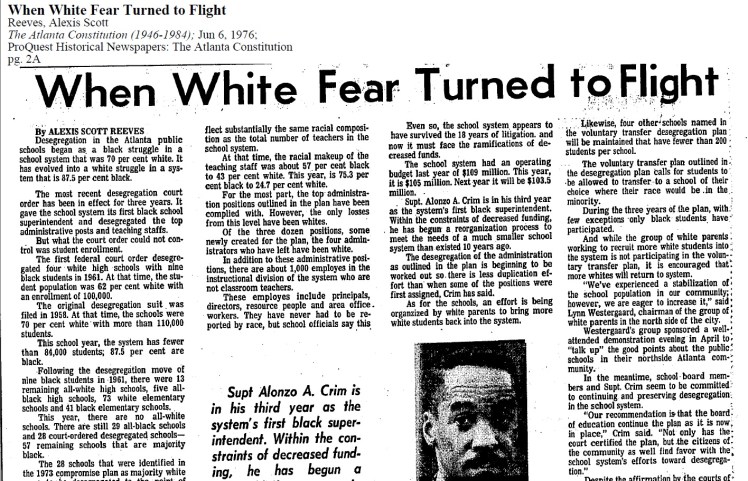
With the desegregation of public schools across the country picking up steam, African-American residents began to slowly move into Adair Park around the mid-1950’s. This drastically changed the demographics of George W. Adair elementary school as white residents refused to participate in school desegregation as well as refusal to sell their homes to potential homeowners of color. By the late 1950’s, racial tensions had reached a boiling point. White residents proudly protested the newly found diversity of Adair Pair, proclaiming that they’d wish for Adair Park to remain for whites only. Some residents even threatened to burn the houses of black residents to the ground ( White Flight, pg 96).  By the 1960’s Adair Park elementary and the surrounding neighborhood had transitioned to a mostly all-African American community. Noticeably absent in the local newspapers is the constant write ups of the Adair Elementary school. One can’t help but wonder if the changing hue of the student body affected the interest of local journalists.


Sources:

  1. https://thegeorgianrevival.wordpress.com/2011/09/22/dougherty-and-robinson-native-arhitects-who-designed-atlanta-landmarks/
  2. https://en.wikipedia.org/wiki/Edward_Emmett_Dougherty
  3. “Adair School Contract Is Let By the Board.” The Atlanta Georgian and News (Atlanta), November 18, 1911, 4th ed. Accessed April 10, 2017. http://dlg.galileo.usg.edu/atlnewspapers/id:aga1911-5562.
  4. Reeves, Alexis Scott. 1976. “When White Fear Turned to Flight.” The Atlanta Constitution (1946-1984), Jun 06, 1. http://ezproxy.gsu.edu/login?url=http://search.proquest.com.ezproxy.gsu.edu/docview/1612082185?accountid=11226.

When White Fear Turned to Flight_6-6-1976

M.C. Kiser Shoe Company – Circa. 1923

This slideshow requires JavaScript.

Name: M.C. Kiser Shoe Company

Location: 141 Trinity Ave, Atlanta, GA 30303

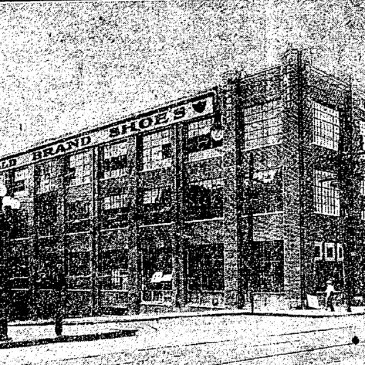
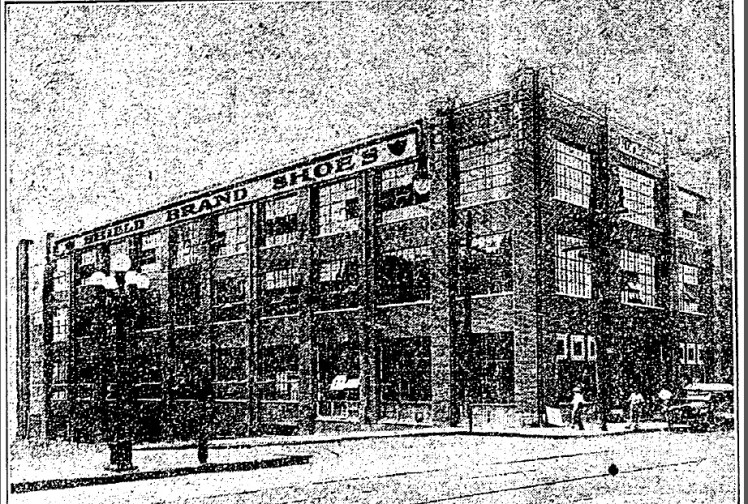
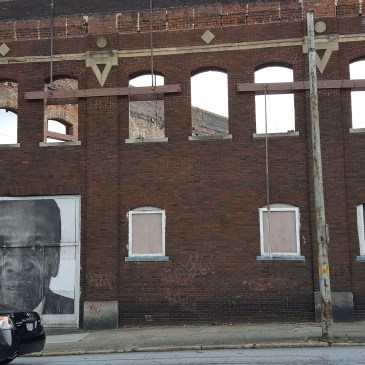
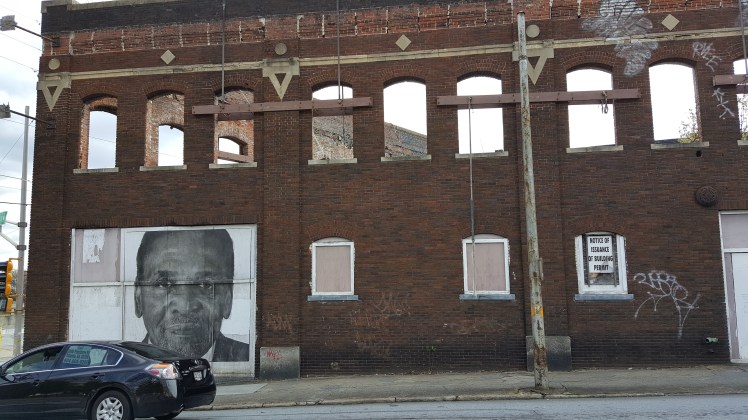
Downtown Atlanta is littered with ornate, abandoned buildings just waiting to be restored back to their former glory. The downtown area is attracting developers as of late, in hopes of revitalizing the once bustling downtown area. As recently as March of 2016, developers were considering converting historic downtown structures into high-end apartments or lofts. One building, in particular, is the well-preserved former shoe factory named M.C. Kiser Company. Built in 1923, the M.C. Kiser Company was once home to one of the most in-demand shoe manufacturers in the S.E. As of late, the project must have stalled because the building remains empty. Oddly enough, it rests two blocks away from the supposed “Upton Hotel.” After a bit of research, I stumbled across local newspaper articles about the M.C. Kiser Company, detailing its rise from a small shoe manufacturing to a larger show manufacturing company in 1923.

M.C. Kiser Co New Building 1923
Source:  New Home of M.C. Kiser Company Corner of S. Pryor and Trinity Avenue. The Atlanta Constitution (1881 – 1945); Sep 2, 1923; ProQuest Historical Newspapers: The Atlanta Constitution pg. B3

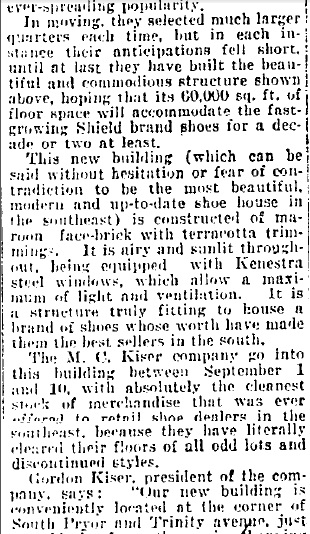
The picture above was printed in the Atlanta Constitution on September 2, 1923, announcing the opening of the new home of the M.C. Kiser Company. Advertised as “conveniently located at the corner of South Pryor Street and Trinity Avenue, just two blocks from the main shopping district,” the Shield Bran shoe manufacturing company’s new home would mark its third move in the thirty-year existence of M.C. Kiser shoe manufacturing company. Their new home boasts 60,000 sq. ft., sunlit rooms, brick facade, and terra-cotta trimmings. Below, is a snippet of the article that accompanied the above picture.


M.C. Kiser Co New Building 1923 article clip

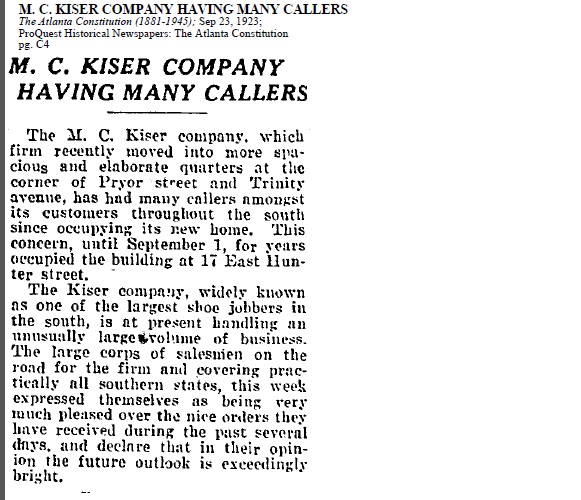
Not too long after the opening of the new home to the Shield Bran shoe manufacturer, M.C. Kiser Company boasts even high sales. The article also mentions the company’s previous location, which apparently was located 17 East Hunter Street, which is now known as Martin Luther King Jr. Drive.

M.C. Kiser Co Sep 1923

Yet another 1923  article after the company moved into their new location.

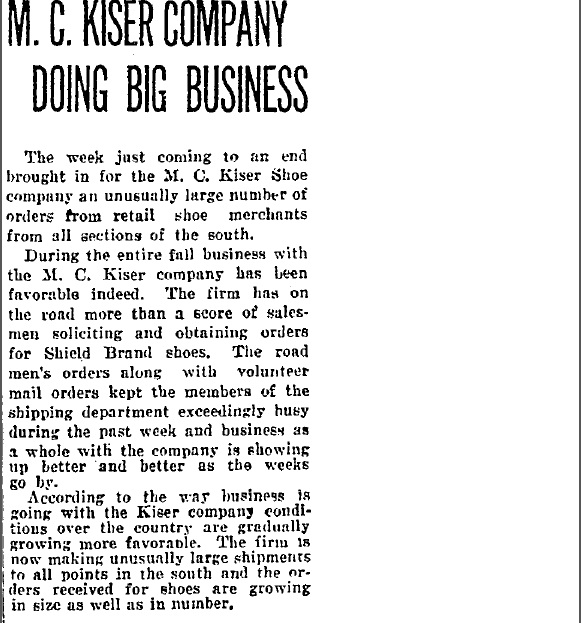
M.C. Kiser Co Doing Big Business Nov 1923

Source:  M. C. KISER COMPANY DOING BIG BUSINESS
The Atlanta Constitution (1881-1945); Nov 4, 1923;
ProQuest Historical Newspapers: The Atlanta Constitution
pg. C7A


1919 article in the Atlanta Constitution speaking of the successes of the M.C. Kiser shoe manufacturing company.

M.C. Kiser Co Sep 1919


Upton Hotel Update – Not a Hotel Afterall?

055
Photo Taken March 11, 2017

In a previous post from March of 2017, I began researching the large, ornate early 20th-century abandoned building on Forsyth Street. Listed as the Upton Hotel on the Atlanta Preservation Center’s website, it appears that the building was never a hotel, to begin with.  This would explain the near impossibility of locating any historical documents mentioning an “Upton Hotel,” it’s as if it vanished into thin air. Initially, construction was planned for a hotel in 1905 to take advantage of the newly constructed Terminus train station nearby.

Apparently, these plans never took place and the “hotel” became a rented space for various businesses over the years. Kudos to local historian Kyle Kessler for revealing the truth behind the “Upton Hotel.” Over the years, the building served anywhere from a 1930’s trunk repair shop, 1970’s pet shop, Dunbar & Sewell brokers firm in 1920, to a 1919 Jos Sykes Bros card clothing company.  Occupied by renters in the early 2000’s, the building was destroyed by a fire in 2002, leaving only a weakened shell.

Below you will find a series of photos detailing the many changes that occurred over the past 80+ years regarding the abandoned, burned shell of a building on Trinity Avenue, Atlanta, GA.

Abandonded downtown building 1899
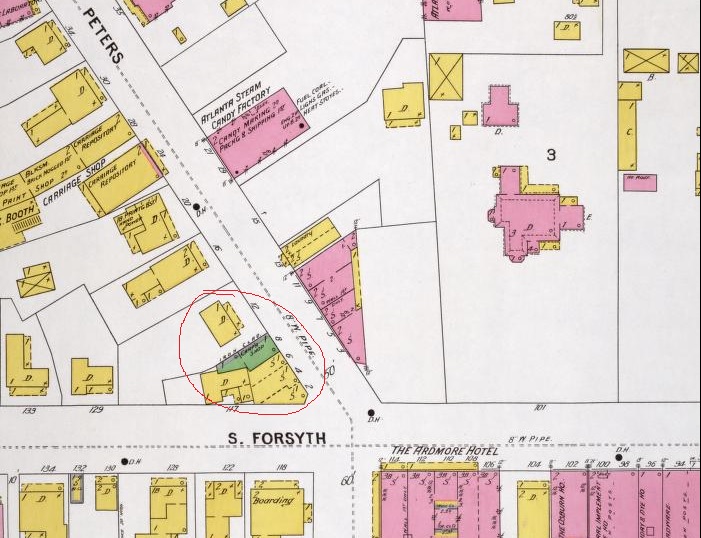
1899 Sanborn Map of abandoned building on what is now called Trinity Avenue
Trinity Ave Building 1911
1911 Sanborn Map of  the building in question

This slideshow requires JavaScript.

What caused the developers to change their minds concerning the initial plans for a hotel? Why did the building go through various vacancies and short-lived leased businesses in its 91 years of operation? Perpahs the location did not prove itself to be as fruitful as the developers had hoped.

David T. Howard – The Man Behind the Name

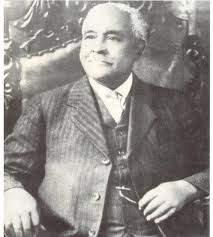
David T. Howard

Black History Month has revealed the faces and names of notable African-American’s and their contributions to American history. Black History Month also manages to omit the names of quite a few more African-American’s that deserve recognition, even if they are relegated to being “hometown heroes.” David Tobias Howard deserves recognition during the month of February and beyond.

Through research, I’ve discovered that David T. Howard was quite accomplished and well known throughout the city of Atlanta. As a successful undertaker, Howard was lauded as premier Negro undertaker or funeral services owner, enjoying over 50 years in service.

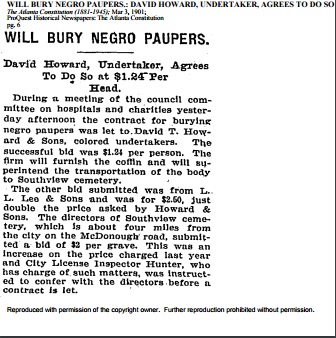
David T. Howard advertisment 3.3.1901

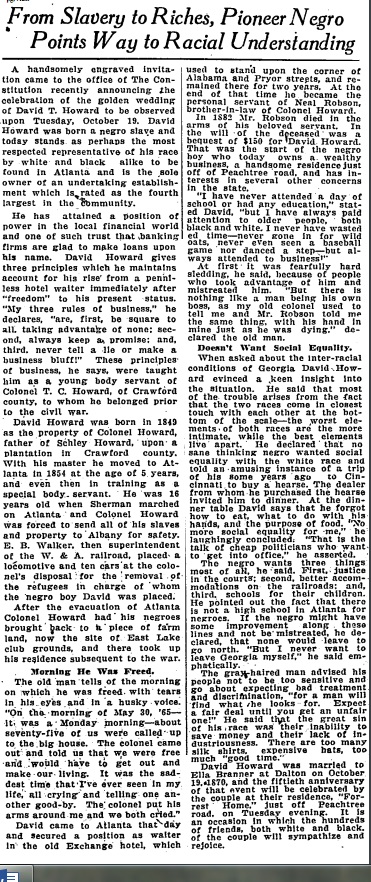
It appears that David T. Howard was a smart businessman when it came to capitalizing off of racial segregation within the city of Atlanta.   On March 3, 1901, The Atlanta Constitution posted an article stating David T. Howard’s decision to bury all Negro paupers who otherwise could not afford funeral services. Howard’s decision allowed the poor to be buried in dignity. It was quite interesting to also see a mention of the historic Southview cemetery as well. Howard outbid two other funeral homes to win the contract at $1.24 per body. Seems kinda morbid, but it obviously worked.


David T. Howard Business From Slavery to Riches- Oct. 17, 1920 Atl. Constitution
The Atlanta Constitution – October 17, 1920


Just 19 years later, the Atlanta Constitution published another article lauding the success of Howard’s business. It reads as a “rags to riches” story and a bit autobiographical as well. Howard recalls how it felt to be a free man, and how he ultimately became the owner of the fourth largest funeral home in Atlanta. As per usual, the discussion quickly segways into the political and social commentary territory. Given the era, I’d have to give Howard a pass, but if his words were spoken in today’s era they would certainly be considered controversial. His opinions on race relations and equality are similar to Booker T. Washington’s ideas where he seems to place the responsibility of racial harmony upon the backs of African-American’s. Perhaps I am misunderstanding his comments, but these comments may have sparked criticism from W.E.B. DuBois at the time.

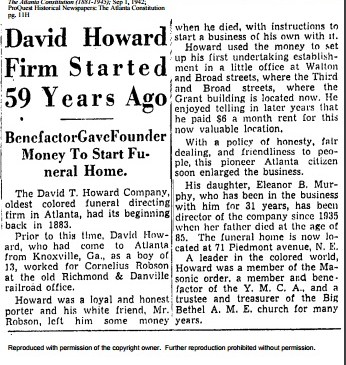
On April 18, 1935, David T. Howard passed away. The Atlanta Constitution featured a lengthy and positive write up about the successes of David T. Howard. He’s described as a great loss to the African-American race, as well as the business world. Upon his death, several tributes to David T. Howard were conducted throughout the city, including notable performances by the Morris Brown College choir as well as the David T. Howard Highschool sextet. David T. Howard’s funeral company would eventually be taken over by his daughter Eleanor B. Murphy as mentioned in a 1942 The Atlanta Constitution article.

This slideshow requires JavaScript.

Source:

From Slavery to Riches, Pioneer Negro Points Way to Racial Understanding.” The Atlanta Constitution (1881-1945), Oct 17, 1920. 1, http://ezproxy.gsu.edu/login?url=http://search.proquest.com.ezproxy.gsu.edu/docview/497731971?accountid=11226.

David T. Howard High School – Pt. 2

David T. Howard opened in 1947 (formerly an elementary school of the same name) as Atlanta’s second high school dedicated to the African-American community. The only other high school for African-American’s was Booker T. Washington high school which remains in use. At one point, David T. Howard high school housed over 2,000 pupils!

The Atlanta Consitution regularly posted graduation updates of David T. Howard every year of its existence as a high school. Notable alumni include:

  1. Eldrin Bell – Former Chief of Atlanta Police Dept
  2. Nathaniel Bronner, SR – Philanthropist and World renown leader in the black hair care industry. Every native Atlantan is familiar with his brand.
  3. Clarence Cooper – Judge of Georgia Court of Appeals; Federal Judge of U. S. District
    Court.
  4. Walter “Walt” Frazier – Profession basketball player for the New York Nicks.
  5. “Bitsy” Grant – Famous tennis champion who has a park named for him on Howell Mill Road.
  6. Louis Johnson – Attended David T. Howard elementary became a Tuskegee Airmen.
  7. Vernon Jordan –  Accomplished former Executive Director of Urban League and close adviser to President William Jefferson Clinton’s.
  8. Lonnie King – Civil Rights Activist
  9. Dr. Martin Luther King Jr. – Civil Rights Activist, minister, and recipient of the Nobel Peace Prize.
  10. Herman Russell – Millionaire Atlanta construction baron and distinguished member of 100 Black Men.
  11. Carl Wright – Entertainer, TV, Movie, Radio personality
  12. James Williams – Famous ParaOlympian
  13. Margaret Matthews Wilburn – Georgia Sports Hall of Fame inductee, Olympic Bronze Medalist, World Championship gold medalist.

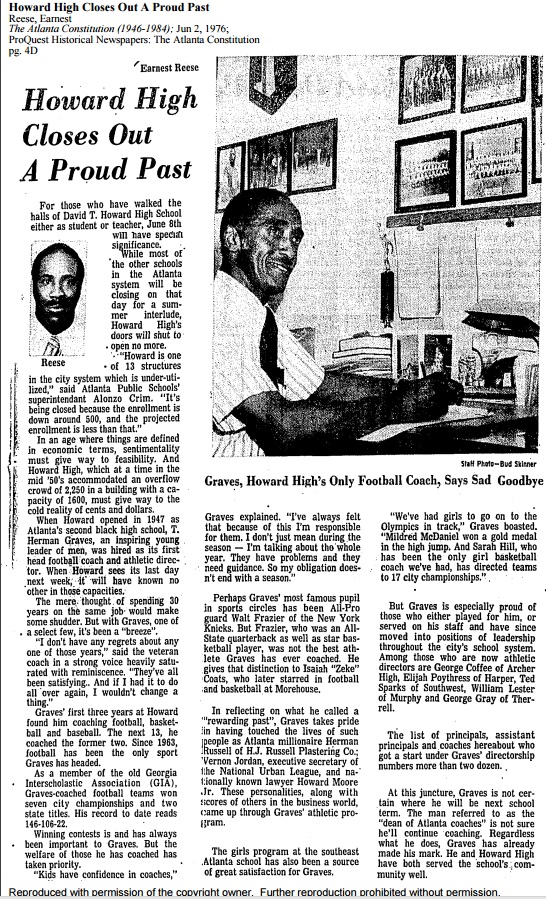
Newspaper Article - End of David T. Howard Highschool

Despite the successes of David T. Howard High, poor attendance caused the school to shutter its doors forever in 1975. After peaking at over 2,250 students, the school’s attendance dropped to a little under 500. One could blame the rising crime in the area, but one could mostly assume that the desegregation of Atlanta Public Schools contributed to the decline of David T. Howard HS. With more options of schools to attend, African-American students enrolled elsewhere, making David T. Howard a relic of a forgotten segregated past.

Further Reading:

  1. http://www.georgiasportshalloffame.com/pdf_files/inductees/track_and_field/margaret_matthews_wilburn.pdf


David T. Howard High School

This slideshow requires JavaScript.

Name: David T. Howard Highschool

Address: 551 John Wesley Dobbs Ave, Atlanta, GA 30312

Anyone passing through the  Old Fourth Ward area of Atlanta couldn’t help but notice the large, brick building occupying a large plot of land on John Wesley Dobbs Avenue (formerly known as Houston Street). Not to long ago, this building served as Atlanta Public School’s archives and museum. However, today it remains fenced in and abandoned awaiting demolition or renovation.
The building itself appears to be in decent shape from the outside. I recall entering this building as a child and remarking at how large the building was, but also saddened by the peeling paint and rusty, dripping pipes overhead. The APC museum and archives have since moved, leaving the old high school without an owner. In typical Atlanta fashion, developers have thought of renovating the old high school and convert it into lofts. Similarly to Bass Lofts in Midtown or various other abandoned school turned loft projects throughout the city.

But what is the history behind the David T. Howard building and its name? Built in 1923, the David T. Howard building was initially utilized as an elementary school before converting into a high school sometime in the 1940’s. With famous alumni such as Martin Luther King Jr., Titus Turner, Lonnie King, and Herman J. Russell, you’d think the enormous brick structure would be designated as a historic landmark or at least marked by a historical marker. Alas, such is not the case.

The story of behind the school’s namesake is equally interesting. David T. Howard was named after David T. Howard, a former slave who amassed massive wealth. He became one of the few Negro millionaires in Atlanta, acquiring his wealth from being a successful undertaker. Not only was David T. Howard wealthy, he was also a philanthropist, devoting a large portion of his fortunes to the advancement of the African-American community in Atlanta; thus the David T. Howard building was created.


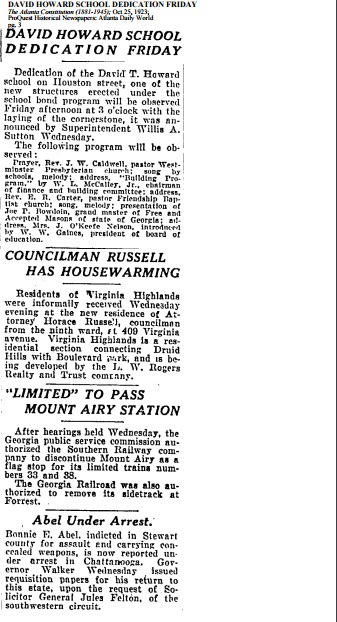
David T. Howard school dedication 10-25-1923
The Atlanta Constitution article on the dedication of the newly opened David T. Howard school. October 25, 1923


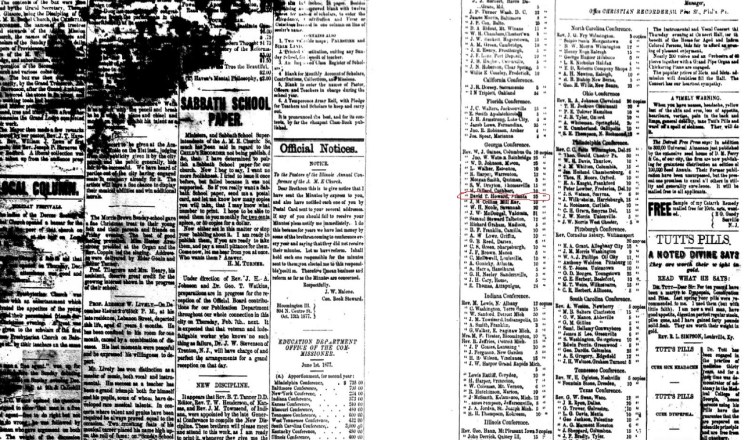
David T. Howard’s hard work and dedication to the community was recognized by the African-American newspaper named the Christian Recorder, January 3, 1878. The Christian Reporter newspaper, stationed in Philadelphia, listed David T. Howard as one of its illustrious laborer’s (Vol. XVI; No. 1), awarding him with 25 copies of the newspaper, possibly for distribution to the local Columbus, GA community. The Christian Reporter was an African-American newspaper of the African Methodist Episcopal Church, dedicated to providing the African-American community with religious and secular news pertaining to African – American’s.

David T. Howard Christian Reporter Newspaper

As the surrounding neighborhood grew more crime-ridden and dangerous, and  with the addition of desegregation of Atlanta PublicSchools, David T. Howard’s enrollment (now a high school) sharply declined in the 1970’s causing Atlanta Public School’s to shutter its doors in 1976. Fast forward to the 21st century, David T. Howard is encased in a black metal fence, forever shut out from the public. Currently, the surrounding fields are utilized by local soccer teams, however, the building itself remains unused.

Further Reading:

  1. http://www.clatl.com/news/article/13074894/save-the-david-t-howard-school
  2. http://www.myajc.com/lifestyles/david-howard-from-georgia-slave-atlanta-philanthropist/BlsNK0GcM6WPKVGIf43SBK/
  3. http://www.clatl.com/news/article/13082077/history-lesson

Sources:

  1. DAVID HOWARD SCHOOL DEDICATION FRIDAY. 1923. The Atlanta Constitution (1881-1945), Oct 25. http://ezproxy.gsu.edu/login?url=http://search.proquest.com.ezproxy.gsu.edu/docview/499005610?accountid=11226.


Remanants of Cornelia Street – Atlanta, GA

Location:  Intersection of Decatur Street and Cornelia Street

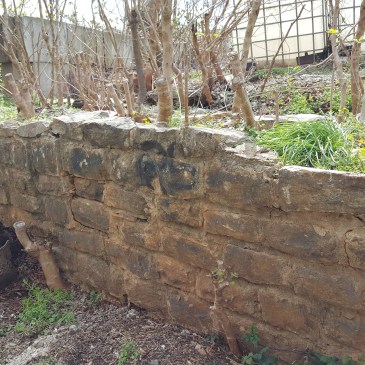
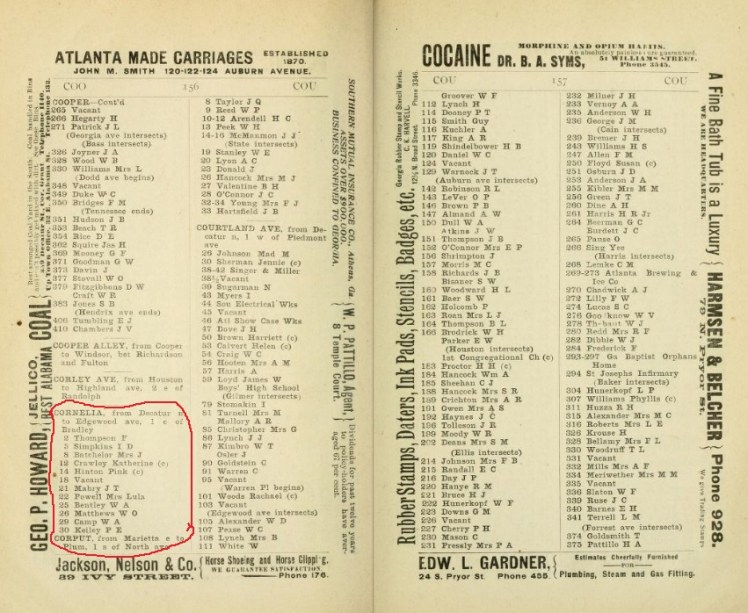
While traveling near the Inman Park-Renoyldstown neighborhood a few weeks ago, a detour from my normal route brought me to a very narrow street named Cornelia Street. Initially, I was drawn to the colorful art on the weather-beaten fence, but my eyes were immediately drawn to the weathered bricks and stairs. The old walls and stairs appear to be remnants of homes from the earlier 19th and 20th century. Using the Sanborn Fire Maps as well as the Atlanta City Directory, I was able to not only determine that homes once occupied these abandoned lots, but also found the names of the occupants.


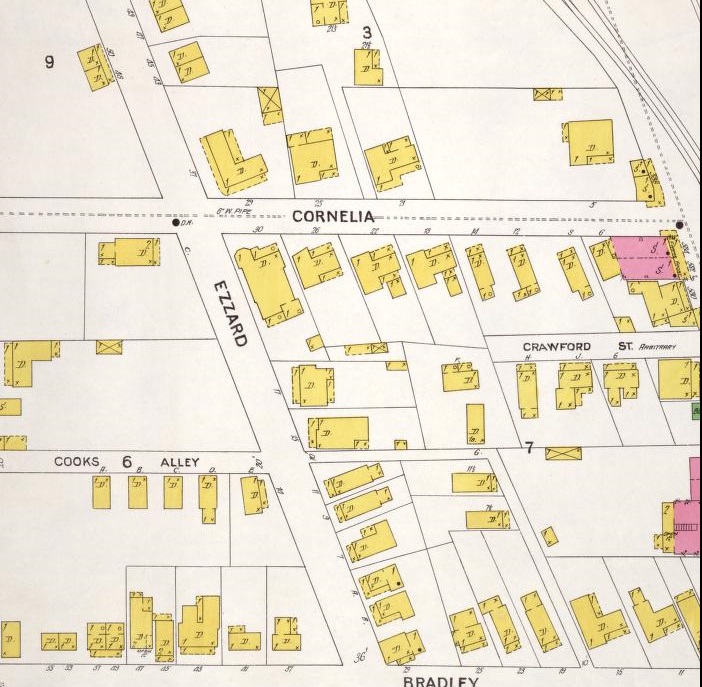
Cornelia St and Decatur St 1899

From the Sanborn Map of 1899 above, as you can see the homes were labeled house number 14, 12, 13, 3. 5 and 6 with shops faces Decatur Street. According to the Atlanta City Directory from 1899, residents that occupied Cornelia Street were apparently desegregated, though it is unknown what occupations the residents held. In 1899, a resident by the name of I.D. Simpson occupied #5 Cornelia St. What I found most interesting was the names of the black residents who occupied houses number 8, 12 and 14. Their names were Amanda Crockett (#8), Katherine Crawley (#12), and Sallie McCall (#14).  According to the Atlanta City Directory, Katherine Crawley did not have an occupation listed, while Amanda Crockett and Sallie McCall were listed as washerwomen. Apparently, this portion of Cornelia Street was a working-class segment of the neighborhood. However, it must have been unusual for the times to have mixed-race inhabitants in 1899 Atlanta, GA. P

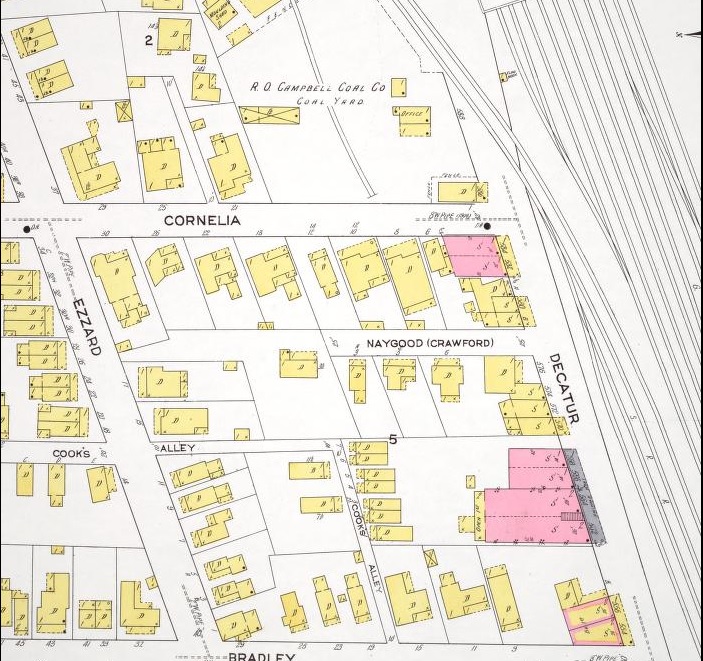
Cornelia St & Decatur St 1911

The above maps details Cornelia Street in 1911, a decade later than the previous map above. According to this map, R.O. Campbell Coal Company occupied a large portion of this area. Which means the area must have been working-class and rather industrial. A stark difference in contrast to the suburbs of Inman Park located not too far from Cornelia Street. According to the Atlanta City Directory, the makeup of the residents of Cornelia Street changed as well. Not a single woman occupied Cornelia Street in 1911. What’s more, the racial makeup of Cornelia Street residents changed as well. Of the 12 homes listed in the directory, only one was occupied by a person of color. The Atlanta City Directory lists residents of the 12 homes on Cornelia Street as men, with one being a man of color. Where did the women of 1899 move to and why did they move? Perhaps for better employment opportunities? Could the gender and racial change in the residents of Cornelia Street have something to do with the new R.O Campbell Coal Company across the street?


Cornelia Street ATL City Directory Picture
1899 Atlanta City Directory listing the names of all occupants of Cornelia Street, Atlanta, GA.


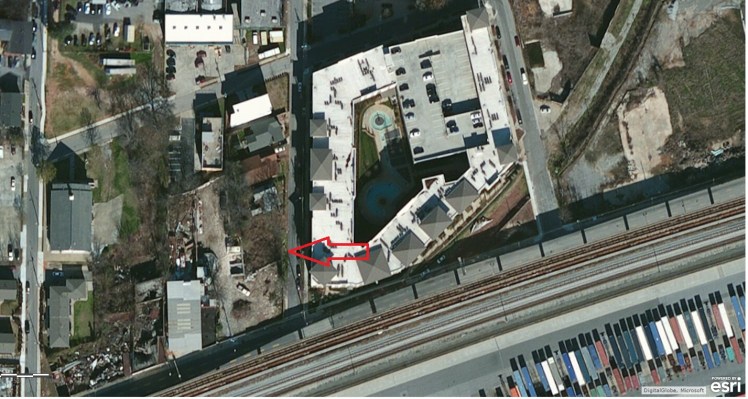
Aerial Shot of Cornelia Street
Modern aerial view of Cornelia Street, Atlanta, GA. The red arrow points to the past location of the homes researched in this article.


Further Reading:

  1. https://archive.org/stream/atlantacitydirec1913atla#page/160/mode/2up